
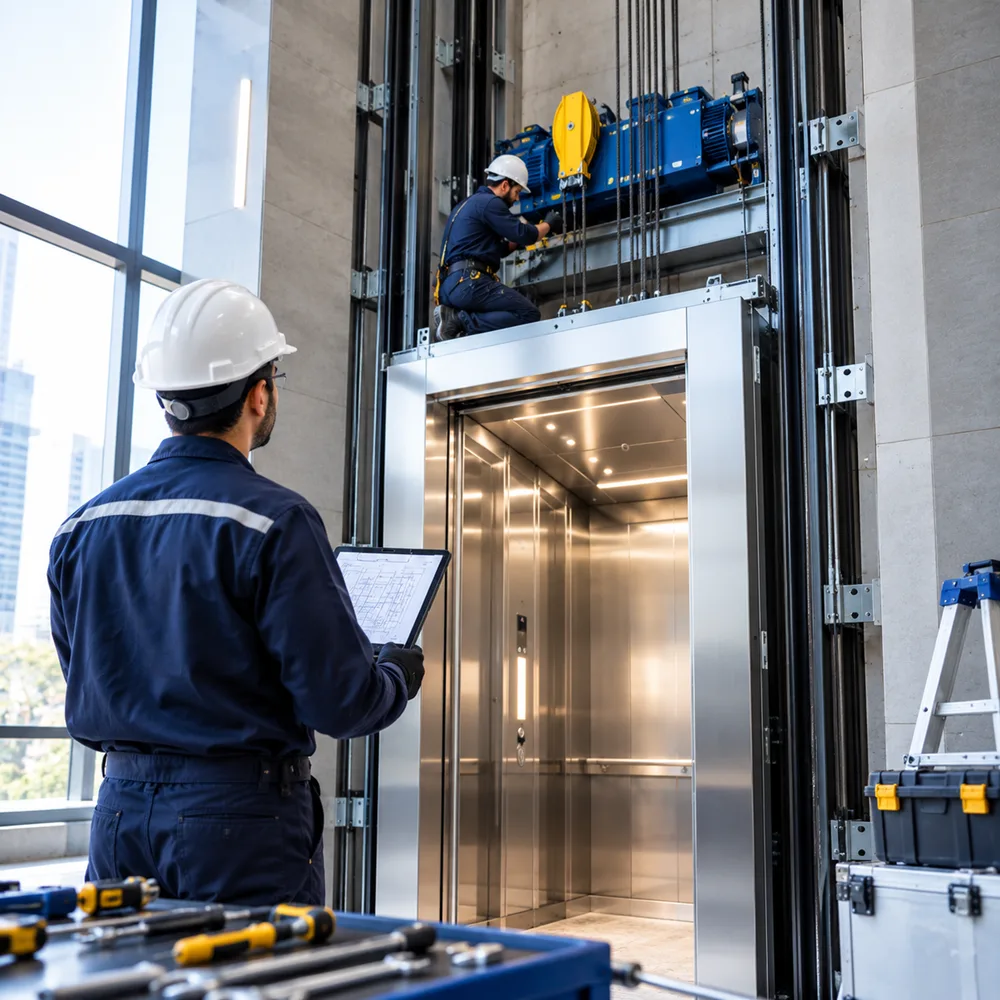
In modern construction, an elevator is no longer simply an amenity; it is an essential part of a building’s vertical transportation system, safety, and residents’ experience. Elevator installation and commissioning directly affect equipment efficiency and service life, while also providing peace of mind for clients and end users.
Drawing on technical expertise, extensive experience, and a commitment to international standards, Tamkin Foulad Asanbar works alongside you to carry out this essential process to the highest standard.
Why Is Professional Elevator Installation and Commissioning Essential?
Professional elevator installation and commissioning go beyond a purely mechanical process. They are essential to ensuring the safety, reliable performance, and service life of this vital building system. This complex process requires extensive technical knowledge, sufficient experience, and strict adherence to national and international standards and regulations, and directly affects users’ lives and well-being.
Any negligence or error during installation—from initial calculations and infrastructure checks to final adjustments and performance testing—can lead to accidents, recurring technical faults, higher repair and maintenance costs, and a significantly shorter elevator service life. Professional installation teams use specialist tools, up-to-date techniques, and technical expertise to ensure that all components are correctly positioned, connections are secure, safety systems are fully operational, and the elevator enters service with maximum efficiency and minimum risk.
Investing in professional elevator installation therefore provides comfort and convenient access for residents and visitors. More importantly, it is an irreplaceable investment in safety and the protection of human life, which must be treated as an unquestionable priority.
Beyond Physical Installation: Safety, Standards, and Peace of Mind
Installing an elevator involves much more than connecting a few components and starting a system. It must be carried out with the utmost precision and in accordance with recognized international standards. The following points explain why choosing a specialist team is essential:
- Full compliance with standards: Carrying out the project in accordance with EN 81 and Iranian national regulations is fundamental to elevator safety and efficiency.
- Accident prevention: Proper installation directly helps prevent accidents and protect lives.
- Longer elevator service life: Correct installation reduces wear and improves long-term system performance.
- Lower future costs: Unprofessional installation leads to frequent repairs, rework, and unexpected expenses.
- Standards certification: Following technical principles throughout installation is necessary to obtain the required permits and standards certification.
Elevator Installation and Commissioning at Tamkin Foulad Asanbar: Step by Step toward Complete Confidence
At Tamkin Foulad Asanbar, elevator installation and commissioning are carried out with meticulous care, in accordance with the highest standards and safety requirements, through clearly defined and carefully planned stages. Our aim is to give customers full confidence in the system’s safe and correct operation. The process includes preparing the installation site, fitting the guide rails, car, motor, and control system, and conducting detailed final tests and inspections. It is undertaken by experienced specialist teams using advanced tools, under close technical supervision.
The main objective at every stage is to ensure full compliance with technical requirements, correct assembly, and faultless operation of every system component, delivering a safe, reliable elevator with a long service life. Each step receives careful attention to every detail, including electrical connections, mechanical assemblies, and safety systems, so users have no concerns or uncertainties when the elevator enters service. This comprehensive, step-by-step approach underpins the final quality and reliable operation of elevators installed by Tamkin Foulad Asanbar.
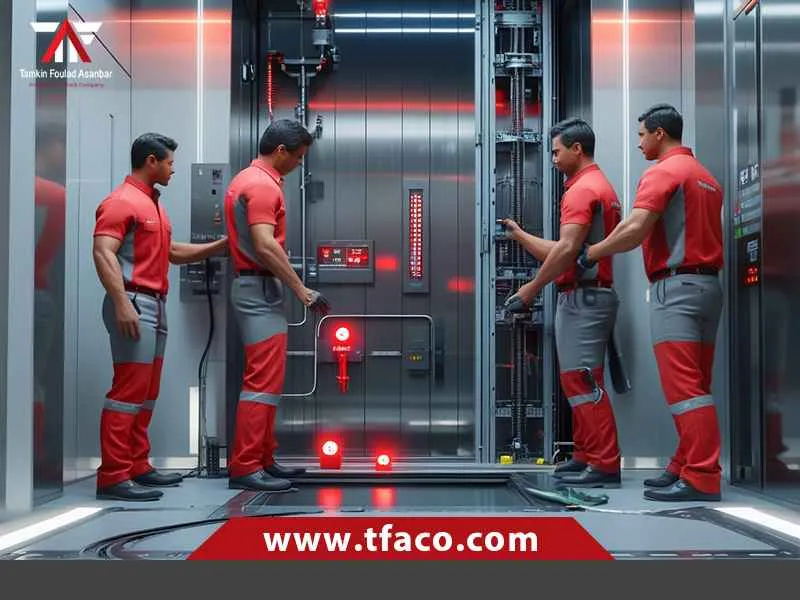
Transparency and Precision at Every Stage: From Initial Visit to Final Handover
At Tamkin Foulad Asanbar, we approach installation and commissioning as a structured, specialist, and transparent process. Every stage is carried out precisely and in accordance with technical standards:
1. Initial Visit and Project Site Assessment
A comprehensive initial site assessment is essential before installing and commissioning any elevator system. An experienced specialist team must visit the site and thoroughly evaluate all relevant conditions. This includes examining the building structure; the dimensions of the existing elevator shaft or its proposed location; access routes for transporting equipment; the required electrical and mechanical infrastructure; natural lighting and ventilation; and possible challenges or restrictions, such as columns, beams, or other structural obstacles along the installation route.
This comprehensive assessment aims both to confirm that the site meets technical requirements and relevant standards and to support accurate, realistic planning for subsequent stages. These include designing a system suited to the existing conditions, preparing reliable cost estimates and work schedules, and reducing risks to prevent unexpected problems and delays during installation and commissioning.
Investing sufficient time and resources in the initial visit and site assessment is therefore an essential step toward the successful, trouble-free delivery of an elevator installation and commissioning project.
- Reviewing drawings and technical documents
- Detailed assessment of the elevator shaft, machine room, and associated infrastructure
- Specialist consultation with the client
- Providing initial technical recommendations
2. Installation Design and Planning
Designing and planning elevator installation and commissioning is a complex, multidisciplinary process. It requires specialist knowledge of civil, mechanical, electrical, and control engineering, together with strict adherence to relevant national and international standards and regulations. It begins with a detailed assessment of project requirements, including the number of floors, anticipated traffic, building use—residential, commercial, office, hospital, or otherwise—and existing spatial and structural constraints.
The appropriate elevator type, such as traction, hydraulic, or gearless, is then selected on technical and economic grounds. Design involves detailed calculations for loads, speed, acceleration, car travel, shaft and machine-room dimensions, and the safety, control, and power-supply systems. Detailed construction drawings covering structural, mechanical, and electrical elements are then prepared to form the basis of installation work.
Installation itself includes building works to prepare the shaft and machine room; fitting guide rails and mechanical components; installing the car and counterweight; wiring and fitting electrical and control equipment; and performing initial adjustments and tests. Commissioning also requires performance and safety testing under specialist supervision and obtaining the necessary approvals from the relevant authorities.
Careful planning of all these stages—including scheduling, resource allocation, and coordination with other parts of the construction project—is essential to complete installation and commissioning safely, effectively, and on time. Continuous supervision and quality control throughout the process are key to ensuring correct and safe elevator operation once it enters service.
- Preparing construction drawings based on actual site conditions
- Precisely scheduling the implementation stages
- Full coordination with civil works teams, electrical teams, and other contractors
3. Equipment Supply and Transportation
Supplying and transporting the equipment required for elevator installation is a critical stage in construction projects. It demands careful planning, effective coordination, and full compliance with safety standards. The process begins with ordering the elevator car, motor, guide rails, control panel, and other essential components from reputable Iranian or international manufacturers, and continues through their safe, timely delivery to the project site.
Appropriate transport methods must be selected according to the equipment’s dimensions, weight, and sensitivity. This requires specialist vehicles, robust packaging, and precautions to prevent damage in transit. Coordination with on-site installation teams, precise scheduling of unloading and movement around the site, and providing suitable access and maneuvering space for cranes or other equipment used to lift heavy components to the required levels are all integral parts of elevator equipment supply and transportation.
Success at this stage directly affects the speed, quality, and safety of elevator installation and ultimately supports the building’s efficient operation.
- Safe transportation of elevator equipment
- On-site quality inspection of components
4. Mechanical Component Installation
Installing an elevator’s mechanical components is a complex, specialist process requiring precision, extensive technical knowledge, and full compliance with safety standards and regulations. It includes the accurate installation and adjustment of all essential components, including guide rails, counterweight, car, motor and gearbox, wire ropes, buffers, and door mechanisms.
Each component is vital to smooth, safe, and efficient elevator operation, and errors in installation or adjustment can have serious safety and performance consequences. Experienced technicians use specialist tools, technical drawings, and instructions to position and connect components correctly.
Carefully aligning guide rails, setting appropriate wire-rope tension, ensuring correct brake operation, and matching components precisely are key steps. This work requires practical skills and a thorough understanding of mechanics, dynamics, and electricity to ensure that the elevator operates safely and efficiently throughout its service life. Successful mechanical installation therefore depends on expertise, experience, and a commitment to the highest industry standards.
- Precise installation of guide rails, car, doors, counterweight, and other mechanical components
- Alignment and adjustment of components in accordance with technical standards
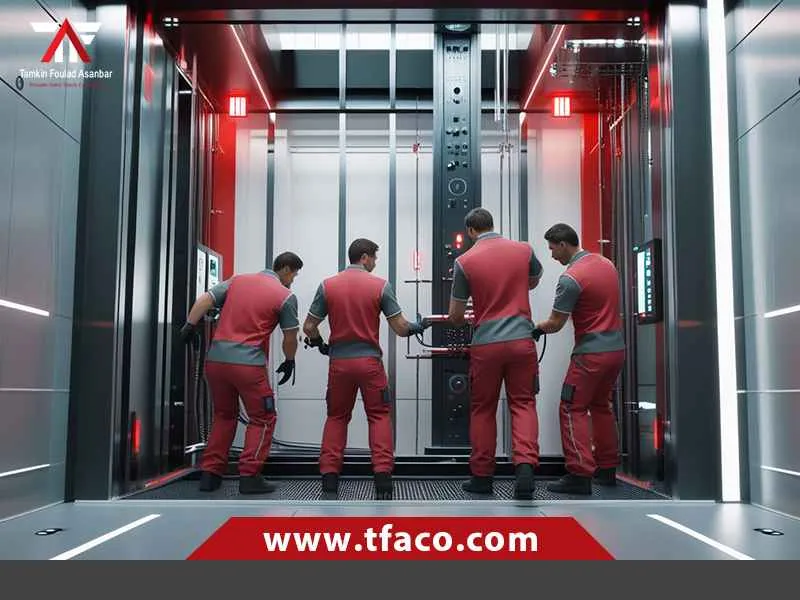
5. Electrical Installation and Control Panel
The electrical equipment and control panel form the heart and brain of an elevator system, playing a fundamental role in its smooth, safe, and intelligent operation. Installing these essential components is specialist work requiring extensive knowledge of industrial electronics and automation control, together with strict compliance with relevant national and international elevator standards and regulations.
As the elevator’s main controller, the control panel manages all aspects of car movement, including floor selection, speed control, monitoring of brakes and safety equipment, and responses to user requests. It contains advanced electronic components, including microprocessors, relays, contactors, variable-speed drives (inverters), and protective circuits, which work together to ensure precise, reliable car movement.
- Wiring in accordance with the drawings
- Installing control equipment and the control panel
- Making safe connections that meet applicable standards
6. Initial Commissioning
Initial elevator commissioning involves a detailed inspection of components, safety settings, and correct system operation before final handover to the customer. A specialist technical team carries out this process to ensure that the elevator complies with safety standards and regulations and is ready to enter service.
- Testing each component’s operation separately
- Checking the complete system during initial startup
7. Final Adjustments
Final elevator adjustments involve carefully checking every component’s performance, precisely calibrating sensors and controllers, and ensuring full compliance with applicable standards and regulations to achieve safe, efficient system operation.
- Adjusting speed, stopping, acceleration, and other operating parameters
- Optimizing performance to suit the project’s requirements
8. Final Testing and Standards Certification
Once final testing is complete and compliance with national and international standards has been confirmed, elevator installation and commissioning certification is issued, demonstrating the system’s safety and satisfactory performance.
- Final testing by the technical team
- Coordinating with the inspection company to obtain safety and standards certification
9. Training Users and the Maintenance Team
Comprehensive training for elevator users and the maintenance team is essential to ensure safety, optimal performance, and lower long-term repair and maintenance costs.
- Training end users in safe elevator use
- Technical training for the project’s maintenance team
10. Final Handover
Final elevator handover includes detailed technical inspections, verification that all components operate correctly, and confirmation of compliance with the necessary standards and regulations. Following final approval, the relevant certificates are issued and the elevator is ready for full operation.
- Complete handover of the elevator with technical documents, drawings, and operating manuals
- Assurance of correct system operation and post-installation support
Tamkin Foulad Asanbar: A Reliable Choice for Your Elevator Installation
Expertise, Experience, and Commitment for Your Projects
Drawing on years of experience and the successful completion of a wide range of projects, Tamkin Foulad Asanbar has established itself as a leading provider of elevator installation and commissioning. Reasons to choose us include:
- Experienced technical team: Trained engineers with extensive technical knowledge
- Advanced tools: Precision equipment for better installation and adjustment
- Safety compliance: Safety is a priority at every stage
- Regular reporting: Detailed reports to the client throughout the project
- Ongoing support: Post-installation servicing and maintenance
- Successful projects: Elevator installations for residential, commercial, industrial, and specialist developments
- Commitment to quality: A focus on customer satisfaction and long-term solutions
Frequently Asked Questions about Elevator Installation and Commissioning
- How long does elevator installation take?
Installation time depends on several factors, including the elevator type, site conditions, building type, and project scope. On average, installation takes between two and six weeks.
- What documents are required for elevator installation?
Technical drawings, ownership documents or a building permit, structural documentation, and the necessary coordination with the municipality and inspection companies.
- What is the role of the standards inspection company?
To oversee the proper execution of installation stages and issue the final approval certificate.
- How are elevator installation costs calculated?
Costs depend on the system type, brand, building height, number of stops, and implementation details. Specialist consultation is necessary for an accurate estimate.
- Are maintenance services available after installation?
Yes. Tamkin Foulad Asanbar provides comprehensive periodic maintenance and technical support.
- Does Tamkin Foulad Asanbar also install elevators from other brands?
Yes. Our technical team can install and commission elevators from a range of brands.
A Step toward Peace of Mind and Confidence
Are you ready to make a dependable choice and give your project the level of elevator installation safety, quality, and efficiency it deserves?
- Contact us for a free specialist consultation.
- Complete the initial site-visit request form, and our specialists will contact you as soon as possible.
- With Tamkin Foulad Asanbar, elevator installation becomes an opportunity for peace of mind and confidence.